Site Search Is Your Biggest Missed Conversion Opportunity

Most companies throw money at paid ads. They rewrite their landing pages every quarter. They A/B test their checkout down to the button color. And almost none of them spend much time on the little magnifying glass in the top right of their homepage.
It's probably the most underused thing on most websites.
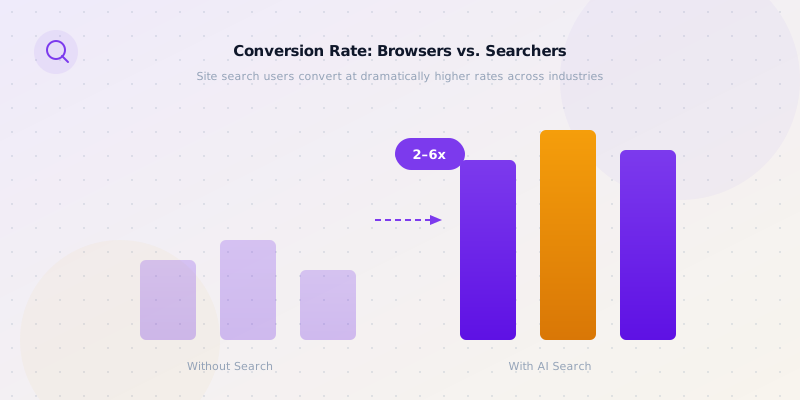
Visitors who use on-site search convert at rates that blow past casual browsers, in pretty much every retail category. And yet most companies invest pennies in making that search actually work.
The Numbers
Different studies cut the data differently, but the shape of the story is consistent.
Algolia pulled together public and internal data from major retailers. Amazon's conversion rate jumps from around 2% to roughly 12% when visitors use search, a six-fold bump. Walmart goes from 1.1% to 2.9%, a 2.4x lift. Etsy sees 3x. Industry-wide, site search users convert up to 50% more often than the average shopper. And although they are usually a small slice of total traffic, they account for close to half of revenue (Opensend, 2025).
The stickier finding: when shoppers feel they have had a successful search, 92% buy the item they came looking for, and 78% add at least one other thing, averaging three extra items per session (Algolia).
None of this should be a surprise. Someone who types a query has explicitly told you what they want. The job is to not get in their way. Most sites still manage to.
Most on-site search is bad
The Baymard Institute, which does this kind of UX research full time, released a 2024 benchmark based on 5,000+ manually scored tests across leading e-commerce sites. The findings are ugly:
- 41% of e-commerce sites fail to properly support key search query types that shoppers actually use
- 33% cannot handle exact product searches reliably (like a specific model name or SKU)
- 36% fail on "use case" queries like "wedding gift" or "winter running gear"
- 38% don't support feature-based queries like "fabric sofa" or "waterproof jacket"
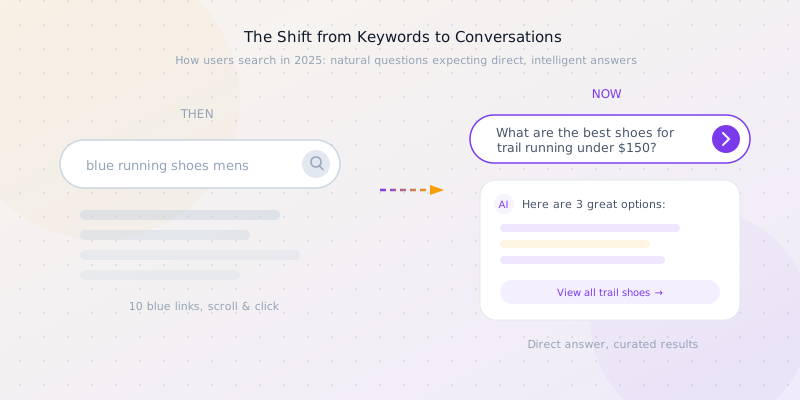
Those numbers all point at the same thing. People don't search in neat, well-formatted keywords. They describe what they want the way they would describe it to a person. They name a feature. They talk about a use case. They misspell things. Most on-site search engines cannot keep up.
Why it stays broken
Mostly, underinvestment. Algolia's own data shows only 15% of companies put real resources into optimizing their site search, and only 7% actually use data from site search to improve anything else in the business.
Meanwhile, the average e-commerce site spends about $92 on acquiring a new customer for every $1 it spends on conversion rate optimization (Econsultancy). It's a pretty striking imbalance. The money goes into getting someone to the door, and then almost nothing goes into helping them find what they came for once they are inside.
Some of this is structural. Search gets installed as a default plugin, left at its default settings, and never touched again. It's treated like spellcheck: a checkbox feature that either exists or does not. But that is a misread of what site search actually is. It's the one surface on your site where your highest-intent visitors literally type what they want to buy. Ignoring that signal is expensive.
What good search looks like now
The shift in serious retail is toward AI-powered search that understands what a query means, not just what words it contains. A query like "comfortable shoes for standing all day under $100" stumps traditional search. It has to parse "comfortable" as a soft attribute, "standing all day" as a use case, and "under $100" as a price filter, and return something that threads all three.
Retailers using advanced search already convert about 2x better on desktop than those on basic keyword matching (Algolia). As AI search matures, that gap widens. Sites on default settings will not feel it gradually. They will feel it all at once.
What to do about it
Look at your traffic. If your site gets 100,000 monthly visitors and 15% of them use search, that is 15,000 high-intent sessions a month. Moving those sessions from a 2% conversion rate to 4% is not a marginal optimization. It's a meaningful revenue number, and it comes from an audience that is already on your site and already asking.
The tooling has caught up too. AI search platforms like brng.ai can plug into an existing site, understand natural-language queries, and return results that reflect how shoppers actually search today. No six-month replatforming.
The short version
Site search is probably the highest-leverage surface most companies still ignore. The visitors using it are the ones most likely to buy. The only question is whether your site can understand what they are asking. Fix that, and the conversions come from visitors you already paid to acquire.
Sources
- Algolia - "40+ Stats on E-Commerce Search and KPIs"
- Baymard Institute - "The 8 Most Common Search Query Types (2024 Benchmark)"
- Opensend - "13 On-Site Search Conversion Rate Statistics" (June 2025)
- Econsultancy - Conversion rate optimization spending benchmarks