From Keywords to Conversations: How Search Behavior Is Evolving

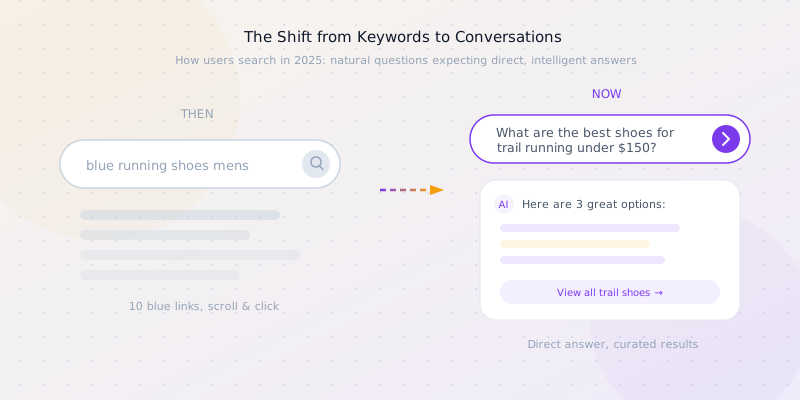
For twenty years, searching online was the same basic routine. You thought of a few keywords, typed them into a box, skimmed the blue links, clicked a few, and pieced together your own answer. That is how everyone learned to look things up.
That is not how people want to do it anymore.
In 2025 the way people search changed faster than most of us expected. How people phrase questions, where they start, what they consider a "good" result: all of it is moving at the same time. And if your website still assumes the old behavior, you are going to feel it.
The numbers behind the shift
Google's own Year in Search 2025 data is the cleanest place to start. Conversational "tell me about" queries were up 70% year-over-year. "How do I" searches hit all-time highs, growing 25% (TechBuzz). That is Google telling on itself. People are asking Google the way they would ask a person.
This is not limited to Google. A March 2025 survey found 52% of U.S. adults had used an AI large language model, and roughly two thirds of them were already using it like a search engine (TTMS). By August, a HigherVisibility study of 1,500 Americans showed daily AI use had more than doubled in six months, from 14% to 29.2%. The share of people who had never used AI for search dropped from 28.5% to 16.3% in the same stretch.
ChatGPT's slice of general information queries tripled during that window, from 4.1% to 12.5%. Google's share slipped from 73% to 66.9%, its sharpest six-month decline in years (HigherVisibility, August 2025).
What is actually changing
A few things are happening at the same time, which is probably why it feels so fast.
Conversational AI went fully mainstream. ChatGPT now has somewhere north of 900 million weekly active users (Superlines). Google's AI Overviews are shown to 1.5 billion monthly users. These stopped being "early adopter" numbers a while ago.
Expectations reset quickly. Once people got used to asking a question and getting an actual answer, their patience for clicking through ten blue links dropped off. If a visitor types a real question into your site's search bar and gets back a wall of loosely related product listings, it feels clunky. That comparison is everywhere now.
Younger users are ahead, but it is not a young-people-only story. 53% of Gen Z say they would check TikTok, Reddit, or YouTube before Google for certain queries (Writesonic). And over half of U.S. adults earning under $50,000 have used an LLM (TTMS). Whoever your customers are, most of them are probably in that group now.
Multi-platform search
One of the more useful findings from the 2025 research is that people have stopped being loyal to a single search destination. HigherVisibility found 34.8% of respondents had actively changed their search habits in the prior six months. Six months earlier that number was 27.7%. The change is still accelerating.
In practice: general knowledge goes to ChatGPT. Local stuff goes to Google Maps. Products go to Amazon, or increasingly TikTok. How-tos go to YouTube. Nobody sits at a single search engine for everything anymore.
For a website owner, this means the search on your own site is competing with all of it. If someone lands on your site (from Google, an Instagram link, wherever) and your search cannot handle a real question, they have ten other places to go.
What this means if you own a website
A few practical things.
Your internal search has to handle intent, not match strings. If someone on your outdoor gear site types "what's a good waterproof jacket for hiking in Scotland in spring," the results should reflect all of that: waterproofing, weight, likely temperature range, breathability. The old keyword approach grabs everything tagged "waterproof" and "jacket" and calls it a day.
The content underneath matters more. AI systems (Google's Overviews, ChatGPT, a search widget on your own site) do better with clear, structured, accurate copy. If your product descriptions read like template filler, nothing downstream will work well.
The search bar is becoming the main experience. For a lot of visitors it's the first thing they touch. A bad search experience no longer just costs a transaction. It tells the visitor your site does not understand them, which is the worse of the two problems.
Where this is going
Gartner expects 50% of online searches to involve an AI assistant by 2028, and traditional search engine volume to drop 25% by 2026 (Superlines, citing Gartner). Predictions like these are usually directional rather than precise. Either way, the direction is clear.
Whether those exact numbers hit or not, the companies that do well will be the ones whose sites answer the way people are already asking. That goes for Google and ChatGPT. It also goes for the search bar on your own homepage.
Sources
- TechBuzz - "Google's AI-Powered Search Hits Record Highs in 2025"
- TTMS - "When Will AI Search Beat Google? 2025-2030 Forecast"
- HigherVisibility - "How People Search Today: Evolving Search Behaviors" (Aug 2025 study)
- Writesonic - "How AI Has Changed Consumer Search Habits in 2025"
- Superlines - "AI Search Statistics 2026: 60+ Data Points"